
Tata Indica Common Problems in Johannesburg: Faults, Costs & Buying-Used Guide
Beyond the well-known water pump and clutch wear, here's what really catches out Tata Indica owners in Johannesburg: hot-start no-starts, gearbox synchro wear, throttle faults, rust and AC failure, with real Rand costs and a buying-used checklist.
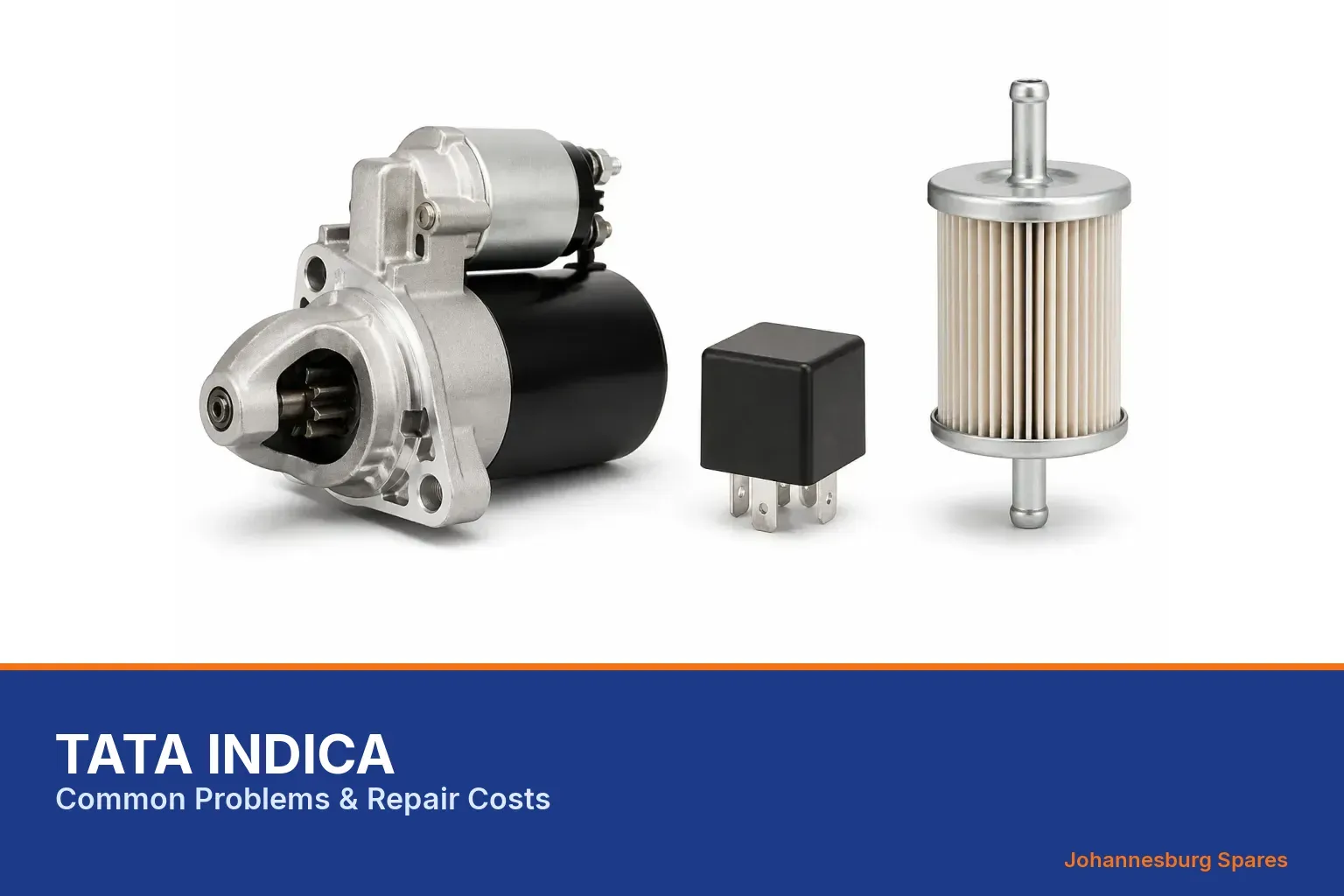
The Tata Indica has been off the new-car price list for years, so every one still on Johannesburg roads is an older, higher-mileage survivor: a used buy that rewards knowing exactly what tends to go wrong. We've already covered the Indica's headline wear items (the water pump, distributor cap and rotor, clutch kit, EGR fouling and the alternator/thermostat combo) on our Tata Indica parts page. This guide goes past that list: the hot-engine no-start that catches owners out, gearbox synchros wearing separately from the clutch, a throttle body fault that can trigger a check-engine light with no stored code, and, most important if you're buying used, exactly where this car rusts first. All with real Rand costs and a checklist for viewing a used Indica before you hand over a deposit.
Key Takeaways
- Hot-engine no-start is a real, documented Indica fault. Cranks fine cold, won't fire once fully warmed up, then starts again after it cools; usually a heat-soaked starter motor or tired relay, not a fuel problem. Budget R900–R3,200 for a starter fix.
- Gearbox synchros wear separately from the clutch. Notchy 1st/2nd gear or a grinding reverse points to worn synchro rings and linkage inside the box, not the clutch disc: a bigger job, roughly R3,500–R7,000.
- DiCOR diesels have a genuine "Limp Home Mode." Tata's own manual confirms the fuel sedimenter deliberately derates the engine if it senses water in the diesel: a quick, cheap fix if you know what it is.
- Rust is the Indica's biggest used-buying red flag. Windscreen frame, door bottoms, wheel arches and the fuel filler cap are the documented weak spots, so inspect these closely even on a car that looks clean.
- Local stock is old and high-mileage. A typical Johannesburg listing is a 2011 model with 170,000+ km, so budget for wear-item repairs rather than hunting for a low-mileage bargain.

Tata Indica DiCOR Fuel System Parts
Fuel filters, sedimenter components and fuel-system parts for the 1.4 DiCOR diesel Indica. Tell us your year and we'll check stock and price it today.
1. DiCOR diesel "Limp Home Mode" when the fuel sedimenter detects water
If you drive the 1.4 DiCOR diesel and it suddenly feels gutless (power drops sharply, the car is restricted to a crawl, and a warning lamp lights up) it's most likely not a breakdown. It's the fuel sedimenter doing exactly what Tata designed it to do. Tata's own DiCOR owner's manual states plainly that when water is detected in the fuel system, "the engine management software will place the vehicle in Limp Home Mode until the water in the fuel is drained" 1. The sedimenter sits ahead of the injection system and separates water from contaminated diesel, which is a real concern on South African forecourt fuel that can carry more moisture than the system expects.
The fix, once you know what's happening, is straightforward: drain the sedimenter per the documented procedure and the car comes straight out of Limp Home Mode. A routine drain and inspection at a workshop is a 10–15 minute job costing roughly R150–R450; if the water sensor or the sedimenter unit itself needs replacing, expect closer to R600–R1,200.
Pro tip: if a DiCOR suddenly loses power and a dash lamp comes on, check the sedimenter before you assume the worst. Tata's manual warns that water left in the system "will damage the engine and components" 1, so don't ignore it, but don't panic either.
2. Hot-engine no-start from a heat-soaked starter motor and worn relays
This is the classic Indica gremlin that catches owners out because it's inconsistent. The car starts fine from cold. Then, after it's been run and is fully warmed up (say, after a stop for fuel or groceries) it cranks normally but won't fire. Leave it for 20–30 minutes to cool down, and it starts again as if nothing happened.
Owners describe exactly this pattern: the car "fails to start when the engine is hot, but starts normally after cooling down," with forum diagnosis pointing to a worn starter armature causing intermittent short circuits once heated 2. A separate aggregator of Indica owner reports lists "starting," "won't start" and "relays" among the most frequently reported fault categories on this model 3. The underlying cause is heat-related resistance building up in worn starter brushes, contacts or relay contacts as under-bonnet temperature climbs, not a fuel or ignition fault, which is what makes it confusing to diagnose the first time.
A reconditioned starter motor typically runs R900–R1,600 fitted; a new aftermarket unit R2,000–R3,200. If the fault traces to a relay rather than the starter itself, that's a much cheaper fix at roughly R80–R220 per relay.

Tata Indica Starter Motors
Reconditioned and new aftermarket starter motors for the 1.4 petrol and diesel Indica, sorted for the classic hot-engine no-start fault. Send us your year and we'll price it.
3. Notchy gear selection and grinding reverse from worn gearbox synchros: not the same as clutch wear
Our Tata Indica parts page already covers clutch kit wear from fleet and e-hailing duty, but that's a friction-disc problem. This is different: worn synchromesh rings and hubs inside the gearbox, plus a tired gear linkage or selector bush. It shows up as difficulty selecting 1st and 2nd gear specifically while other gears feel fine, a stiff or vague gear lever, or occasional grinding when reversing.
An automotive fault-tracking site names the Indica specifically for a "reverse gear problem" (gears getting stuck, difficulty shifting into reverse, clunky transmission noises) attributed to worn gear-selection components 4. A model-specific Q&A on a 1.4 LSi Indica describes the exact diagnostic test worth knowing: if the gearbox still engages gears with the engine off, the fault is more likely the clutch linkage or pilot bearing; if it won't engage gears even with the engine off, the wear is internal to the gearbox itself, pointing to worn synchronisers 5.
Because this needs the gearbox out to inspect and repair properly, it's a bigger job than a clutch kit alone. Reckon on R3,500–R7,000 fitted for synchro ring/hub replacement, a new pilot bearing and linkage bushes.
4. Throttle body and idle faults: rough running with no fault code stored
On the 1.4 MPFI petrol, a rough or hunting idle, hesitation pulling away, and a check-engine light that comes on with no readable fault code at a generic scanner all point to the throttle body. Carbon and varnish build-up restricts airflow and upsets idle control; on higher-mileage cars the throttle body can fail outright rather than just needing a clean.
A Johannesburg-area Indica owner's review is a useful real-world data point here: bought new in 2013, the car developed a faulty throttle body by around 65,000 km, on top of earlier braking and gearbox issues, totalling roughly R45,000 in cumulative repairs by the third year of ownership 6. That's an outlier on the high side, not a typical bill, but it shows the throttle body genuinely fails on this model rather than only needing an occasional clean. A separate Indica fault database independently lists "engine check light illuminated with no error codes detected" as a documented issue 3.
A throttle body clean and idle relearn costs around R150–R350; a full aftermarket replacement unit fitted runs closer to R850–R1,800.
Watch out: don't chase a phantom electrical fault if the check-engine light comes on with no stored code and the idle is rough. Start with the throttle body, since it's cheaper to rule in or out than most owners assume.
5. Power window and cabin relay failures: windows, fan, indicators and central locking
Ageing electrics are a fact of life on any car this old, and the Indica has a specific, documented pattern: power windows that stop winding down or stick partway, a heater or radiator fan that won't respond to the switch despite good fuses, and indicators, radio or auxiliary lights cutting out intermittently.
The same fault-tracking source names the Indica directly under "power windows not working," attributing it to wear in the window regulator's sensor or motor assembly, typically appearing from the car's second year 4. The Indica-specific owner-report aggregator separately lists "relays" as a top fault category, alongside "fan not working despite functional relays and fuses" and "radio and auxiliary lighting failures" as distinct issues 3. None of this points to one design flaw; it's the normal ageing pattern for a car built on a platform this old, but it's worth testing thoroughly before you buy.
A replacement window regulator/motor assembly fitted runs about R450–R950; individual relays are cheap at R80–R220 each. The cost adds up mainly if several have failed at once on a neglected car. Browse our electrical parts range if you need a regulator, relay or fan motor.

Tata Indica Relays & Electrical Parts
Window regulators, fan relays, indicator relays and central locking parts for the Indica's ageing electrics. Tell us what's playing up and we'll quote you.
6. Premature rust at the windscreen frame, door bottoms, wheel arches and fuel filler cap
This is the single biggest thing to check before buying a used Indica in Gauteng, and it's the fault most independently corroborated across sources. The same Johannesburg owner's review that flagged the throttle body also reports the windscreen was dealer-replaced at just 2,500 km, and three years later "my front window is almost rusted away" 6. Independently, a broader Tata fault review documents a "rusting issue" across the range, concentrated "near the fuel filler cap and building up from the wheel wells," attributed to metal exposure and a suspected design weakness, and notes it hurts resale value 4.
Two owner reports from different sources, describing the same panel areas, is a strong pattern for a car this age. It's driven by thinner-gauge steel and under-protected seams trapping moisture, made worse in Johannesburg by summer storm driving and unwashed grit sitting in the wheel arches through winter.
Localised rust cutting, priming and a spot respray of one affected area runs R800–R3,500; if the windscreen frame or a structural sill section needs cutting out and replacing, budget R6,000+.
Good to know: rust here is a used-buying issue as much as a running-cost one. Bubbling paint at the windscreen frame or wheel arches on a car that otherwise "looks clean" is exactly the kind of thing a quick walk-around viewing misses. See the buying-used checklist below.
7. AC compressor failure and weak cooling
Warm or only mildly cool air from the vents, despite the blower running normally, usually points to the AC compressor rather than the blower motor. In more advanced cases the compressor cuts out audibly, often worse under acceleration or in stop-start Johannesburg summer traffic.
An Indica-specific fault database lists "AC compressor failure during acceleration" and "air conditioning unit inoperative" among documented issues on this model 3, and a commercial AC-service pricing page specific to the Indica names low refrigerant charge, a blocked condenser and a faulty compressor as the most common causes 7. The compressor's magnetic clutch and internals simply wear with age and gas-charge cycles.
A new aftermarket compressor typically costs R2,800–R5,500; a tested used or reconditioned unit through the Gauteng breaker-yard channel is cheaper at R1,200–R2,200. If the compressor itself tests healthy, a regas and condenser clean runs R450–R900.
What it costs to fix in South Africa
Here's the quick-reference cost guide for everything above, using typical Johannesburg parts-and-labour ranges. These are in addition to the water pump, distributor cap/rotor, clutch kit, EGR and alternator costs already covered on the Tata Indica hub page.
| Problem | Likely fix | Typical SA cost (fitted) |
|---|---|---|
| DiCOR sedimenter water detection | Sedimenter drain, or sensor/unit replacement | R150 – R1,200 |
| Hot-engine no-start | Reconditioned or new starter motor, or relay | R80 – R3,200 |
| Notchy gears / grinding reverse | Gearbox synchro, pilot bearing, linkage | R3,500 – R7,000 |
| Throttle body / idle fault | Clean and relearn, or replacement unit | R150 – R1,800 |
| Window regulator / relay failures | Regulator, fan or indicator relay | R80 – R950 |
| Rust at windscreen frame, arches, sills | Localised repair, or panel/sill replacement | R800 – R6,000+ |
| AC compressor / weak cooling | Regas, or new/recon compressor | R450 – R5,500 |
Buying a used Tata Indica in Johannesburg: what to check first
Because Indica production ended years ago, every car for sale locally is older and higher-mileage: a typical Johannesburg listing is a 2011 1.4 LE with around 173,000 km, priced near R39,900 8. There's little point holding out for a low-mileage unicorn; budget wear-item repairs into the purchase price instead, and use this checklist on any car you're seriously considering:
- Test a genuinely hot restart, not just a cold start. Let the seller's car idle or drive for 15–20 minutes until fully warm, switch off, and try restarting immediately. A car that cranks but won't fire until it cools is showing the classic starter/relay fault 23.
- Run every power window up and down, and cycle the indicators, central locking and fan on every speed. These fail from the car's second year on and are cheap individually but add up if several have gone at once on a neglected car 43.
- Check reverse and 1st/2nd gear engagement, both cold and after a warm-up drive, listening for grinding or notchiness. This is harder to spot on a quick drive around the block, so insist on reversing out of a parking bay and doing a few full stop-starts in 1st and 2nd 45.
- Closely inspect the windscreen frame, door bottoms, sills, wheel arches and fuel filler cap for bubbling paint or rust, even on a car that looks clean at a glance. This is the Indica's most model-specific red flag and can develop within a few years regardless of mileage 64.
- On DiCOR diesels, ask about the fuel sedimenter drain history and watch for a sediment/water warning lamp on start-up. A car that's spent time in Limp Home Mode from neglected drains is a sign of poor fuel discipline by a previous owner 1.
- Test AC cooling properly on a warm day, not just that the blower spins. A blower that runs but only produces mildly cool air points to a tired compressor or low charge 37.
- Confirm the exact variant (1.4 MPFI petrol or 1.4 DiCOR diesel) and check parts availability against that VIN before you commit. Tata's own SA parts channel has thinned out over the years; the shared Tata-Fiat 1.4 lineage keeps most mechanical parts available, but it's worth confirming before you buy, not after.
Should you buy a used Tata Indica?
If the price is right and you go in with your eyes open, yes. None of the faults above are safety recalls (Tata's public recall channels show no Indica-specific campaign) and most are inexpensive to put right individually. The exception worth taking seriously is rust: it's the one issue that can turn a cheap buy into a resale headache, so don't skip that inspection for the sake of a five-minute test drive.
MotorBeam's long-term owner interview with a 20-year-old, still-running Indica is a good watch for anyone weighing up a used one. Video credit: MotorBeam.
We carry new and quality aftermarket Tata Indica spares (fuel-system parts, starters, electrical components and more) with delivery across Johannesburg. Send us your VIN and the part you need, and we'll come back with a price, usually the same day.
Frequently Asked Questions
What are the most common problems with the Tata Indica beyond the water pump and clutch? Once you're past the well-known water pump, distributor cap, clutch and EGR wear, Indica owners in Johannesburg most often report a hot-engine no-start from a heat-soaked starter motor, notchy gear selection from worn gearbox synchros (separate from clutch wear), throttle body and idle faults on the petrol MPFI, ageing window regulators and relays, premature rust around the windscreen frame and wheel arches, and AC compressor failure. None are subject to a formal safety recall.
Why won't my Tata Indica start when the engine is hot? This is a documented Indica fault, not a sign something is seriously wrong. A heat-soaked starter motor and worn starting relays lose contact quality as under-bonnet temperature rises, so the car cranks but won't fire until it cools down for 20–30 minutes. A reconditioned starter motor typically costs R900–R1,600 fitted, or R80–R220 if the fault is isolated to a relay.
What is "Limp Home Mode" on a Tata Indica DiCOR diesel? It's a genuine, Tata-documented safety feature, not a fault in itself. The DiCOR's fuel sedimenter detects water in the diesel and the engine management software deliberately reduces power until the water is drained, protecting the injectors and fuel pump. A workshop drain and inspection is a quick, inexpensive fix at around R150–R450.
Does the Tata Indica rust badly? Rust is the Indica's most consistently reported issue among South African and international owners, concentrated at the windscreen frame, door bottoms, wheel arches and fuel filler cap. It can appear within a few years regardless of mileage, driven by thinner-gauge steel and moisture trapped in under-protected seams. Always inspect these specific areas closely before buying a used Indica, even on a car that looks clean.
Where can I buy Tata Indica parts in Johannesburg? Johannesburg Spares supplies new and quality aftermarket Tata Indica parts (fuel-system components, starter motors, electrical parts, and more) for both the 1.4 MPFI petrol and 1.4 DiCOR diesel, with delivery across Gauteng. Send us your vehicle details and the part you need and we'll quote you, usually the same day.
Sources
- ManualsLib — Tata Motors DiCOR Diesel Owner's Manual (fuel sedimenter & Limp Home Mode)
- CrazyEngineers — Tata Indica Engine Starting Trouble
- StartMyCar — Tata Indica Reported Problems
- Motor and Wheels — Common Problems With Tata Cars
- 2CarPros — What Could Cause Gear Selection Problems on a Tata Indica 1.4 LSi
- HelloPeter — Tata Indica 1.4 Problems From New Till Now (South African owner review)
- PitCrew — Tata Indica Car AC Service & Compressor Pricing
- AutoTrader South Africa — Tata Indica Listings, Gauteng/Johannesburg
Please note: This guide is general information for South African motorists and not a substitute for advice from a qualified mechanic. Prices, availability and fitment vary by vehicle — always confirm the correct part for your exact make, model and year before buying.